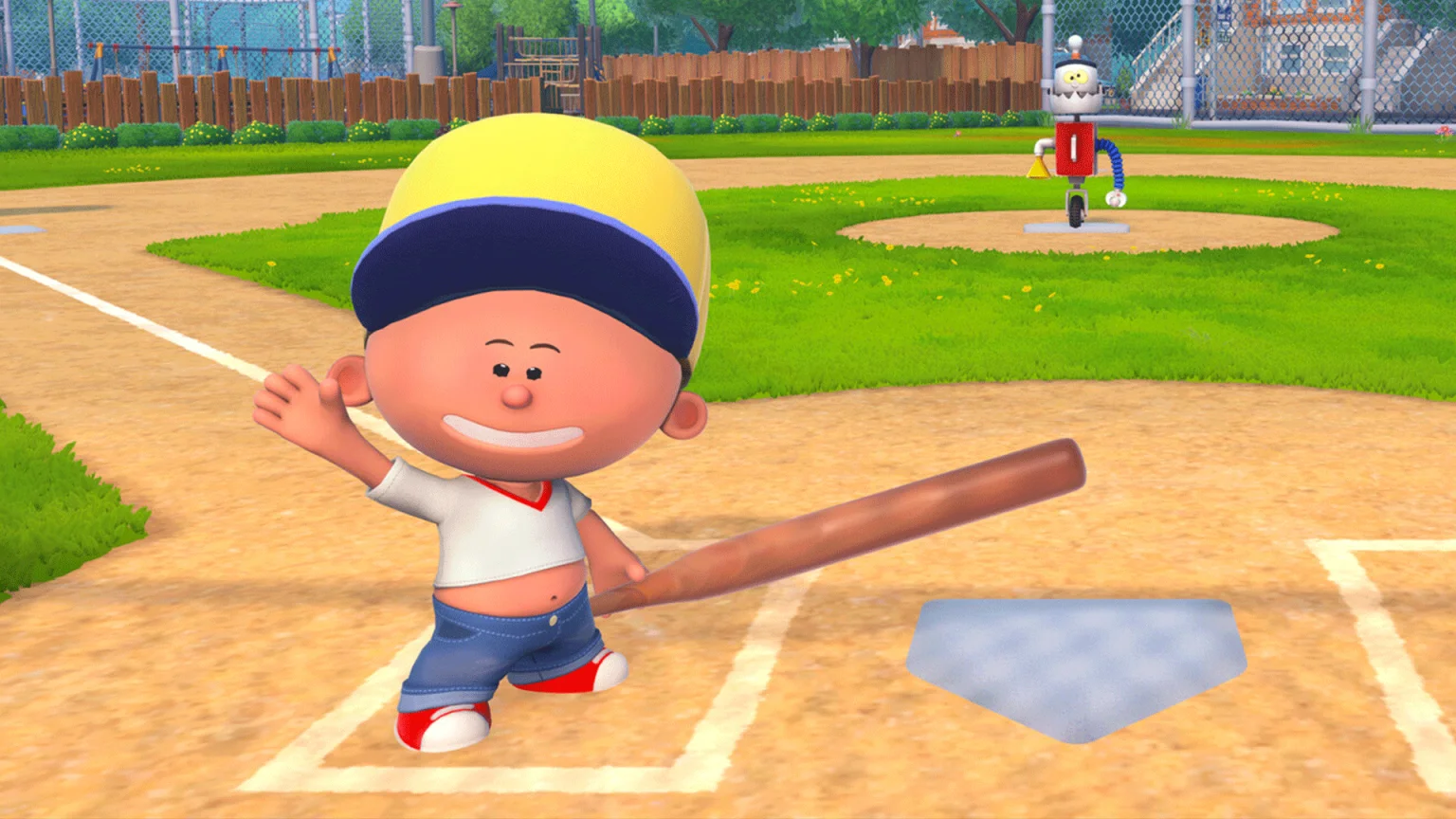

Great athletic achievements require constant, grueling dedication, a truth frequently mirrored in dramatic cinematic training sequences where remaining static is equivalent to regression. For game developers, altering a classic formula can either result in a triumphant breakthrough or an unfortunate misstep that damages the core experience. The newly launched Backyard Baseball reboot from Mega Cat Studios unfortunately represents the latter scenario. While the game successfully preserves the visual nostalgia and charm of the beloved children’s sports series, its mechanical updates suffer under the weight of unnecessary modernization. By overcomplicating the traditionally simple controls for pitching, hitting, and fielding, the developers have introduced optimized systems that feel deeply flawed. Ultimately, while the game looks appealing at first glance, it fails to deliver on the fundamental aspects of gameplay that truly matter to players.
An ironic consequence of these mechanical tweaks is that offensive play feels entirely unbalanced, with nearly every successful bat contact resulting in either a home run or a sharp line-drive single. This pattern does not stem from player excellence – rather, it is the direct byproduct of how the game’s offensive and defensive dynamics have been redesigned. Securing a hit has become remarkably effortless, especially when contrasted with the experience offered by the Backyard Baseball ’97 re-release that launched in 2024. This dramatic drop in difficulty removes much of the competitive tension from the experience.
Batting Mechanics Imbalance
In the original titles, the swing spot assist system was deliberately vague, providing players with a generous circle inside the strike zone to mark the general trajectory while requiring them to accurately time and place their swing. The reboot completely eliminates this guesswork by explicitly pinpointing the exact location where the ball will cross the plate. While the classic approach occasionally caused players to whiff entirely, it rendered successful hits far more satisfying and varied than the current routine outcomes. Now, the gameplay mirrors the extreme statistics of the Major League Baseball steroid era, with players consistently driving the ball out of the park. Had legendary slugger Barry Bonds been included in this roster, commissioner Rob Manfred might have already initiated a formal investigation, though the inclusion of Mark McGwire means a probe into these inflated statistics remains a humorous possibility.
The offensive challenge only escalates significantly when players unlock the maximum difficulty tier, known as Backyard Legend. At this level, opposing pitchers throw with vastly increased velocity, which initially caused issues when utilizing a standard controller on PC due to the slow movement speed of the targeting reticle. However, switching the control scheme to a mouse and keyboard completely neutralized this difficulty spike, allowing for consistent, effortless hits once again.
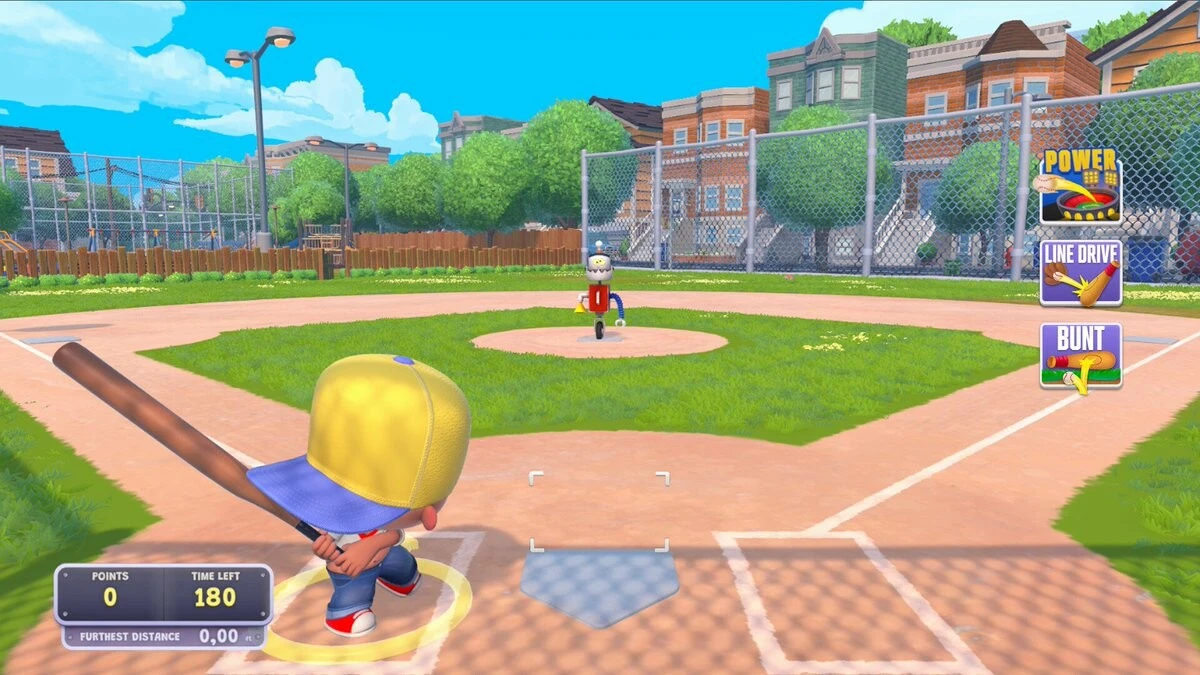
To inject any genuine difficulty into the batting phase, players must completely deactivate the swing spot assist feature, though doing so introduces a different set of mechanical issues. Without the assist, anticipating breaking balls becomes an exercise in futility because reading the ball’s final position within the strike zone is nearly impossible. This creates a frustrating system of extremes where the game is either trivial with assistance or excessively punishing without it. Players are left without a balanced middle ground – forcing them to choose between performing like Babe Ruth or looking completely helpless against consecutive breaking pitches.
Pitching and Defensive Flaws
The pitching mechanics suffer from a similar lack of balance, frequently transforming every player on the mound into a dominant force reminiscent of Greg Maddux. Initially, it appeared that pitching selections had minimal impact and that the AI opponents could easily hit any throw. However, once the player masters the newly introduced pitch release timing system, defensive dominance completely takes over the game. This mastery triggers massive blowouts, with matches regularly concluding in lopsided shutouts or ridiculous scores like 26 – 0 and 19 – 3. While the new system attempts to add skill to a historically straightforward position, players will find that they reach the absolute ceiling of this mechanic far too quickly.
The scoring disparity becomes so severe during double-digit leads that players may find themselves intentionally hitting ground balls directly into opposing fielders just to accelerate the end of the game. Curiously, Backyard Baseball completely lacks a mercy rule to mitigate these tedious situations. When a team secures a massive double-digit advantage by the fourth inning of a standard six-inning contest, ending the match immediately would be the logical choice. Instead, the game forces players to watch characters like Kiesha Phillips blast homers to push a lead to 33 – 5 while fictional opponents like Billy Jean Blackwood suffer in the outfield. It evokes the image of frustrated parents in the stands demanding the umpire call the game to end the unnecessary misery.
The defensive fielding mechanics represent another significant step backward for the franchise. The experience lacks the responsive feel found in classic iterations like ’97, ’01, or the 2003 GameCube edition, where players could fire powerful throws from right field to first base to secure tight outs. In the reboot, fielders exhibit a noticeable lack of urgency and effort. Even disabling the error setting to minimize mistakes cannot compensate for the sluggish throwing animations hardcoded into every single character. Attempting a rapid throw from shortstop to second base frequently results in a slow lob, allowing the opposing team to put multiple runners into scoring position instead of executing a routine double play.
Adding to the frustration is the inability to manually command fielders to sprint or slide when chasing down line drives or pop flies, despite these movement options being fully accessible during baserunning sequences. This design choice leaves the impression that the children are programmed to exert effort exclusively on offense while remaining passive on defense. While accumulating runs is initially exciting, doing so continuously across a full League Play season quickly becomes monotonous. The complete absence of defensive highlights strips away the excitement that naturally comes from turning a brilliant double play, leaving offense as the primary focus while defense is treated like an irrelevant afterthought.
These systemic issues are highlighted further by the computer-controlled AI, which consistently fails to adapt to the player’s strategies or utilize the mechanics effectively. Engaging in local multiplayer with friends offers a brief respite and keeps the matches competitive, but this option is entirely absent from the single-player season mode that serves as the game’s core feature. Furthermore, the highly anticipated online PvP mode suffered a delay right before the official launch. While competing against real human opponents could potentially refresh the gameplay, that remains purely theoretical until the online infrastructure is formally implemented.
Roster Variety and Added Features
Youth baseball coaches universally emphasize the critical importance of mastering basic fundamentals. Unfortunately, the flaws in this Backyard Baseball reboot are deeply foundational, negatively impacting every facet of the presentation and performance. A prime example is the new Wiggle Ball mode, which introduces significantly upgraded artwork and animations that represent a massive visual leap over the original titles. Operating as a fast-paced 4v4 alternative to the standard 9v9 Pick-Up and League Play modes, it allows players to engage in quick matches using a slippery wiffle ball without the need to manage complex lineups or commit to an entire season.
Yet, the flawed hitting and pitching systems ensure that the outcome of these Wiggle Ball matches becomes entirely predictable almost immediately. After an initial adjustment period to account for the erratic, looping trajectory of the ball, the competitive challenge vanishes completely. Even when facing advanced pitches like Luanne Lui’s signature triple-loop left hook deluxe, players can effortlessly drive the ball over the right-field fence with a standard contact swing, leading to massive scores that resemble the career batting average of Chipper Jones.
Fortunately, the game includes certain elements that remain unaffected by these core gameplay issues. Moving away from standard tutorials and batting modes, the developers introduced an engaging feature called the Card Shop. Here, players can purchase and open three distinct tiers of card packs containing character profiles, special items – such as Achmed’s signature headphones or Reese’s inhaler – and unique offensive or pitching maneuvers like the Line Drive hit and the Slowball pitch. Crucially, the game completely eschews real-money microtransactions, relying instead on in-game Tokens earned naturally by completing Quick Play or Season matches.
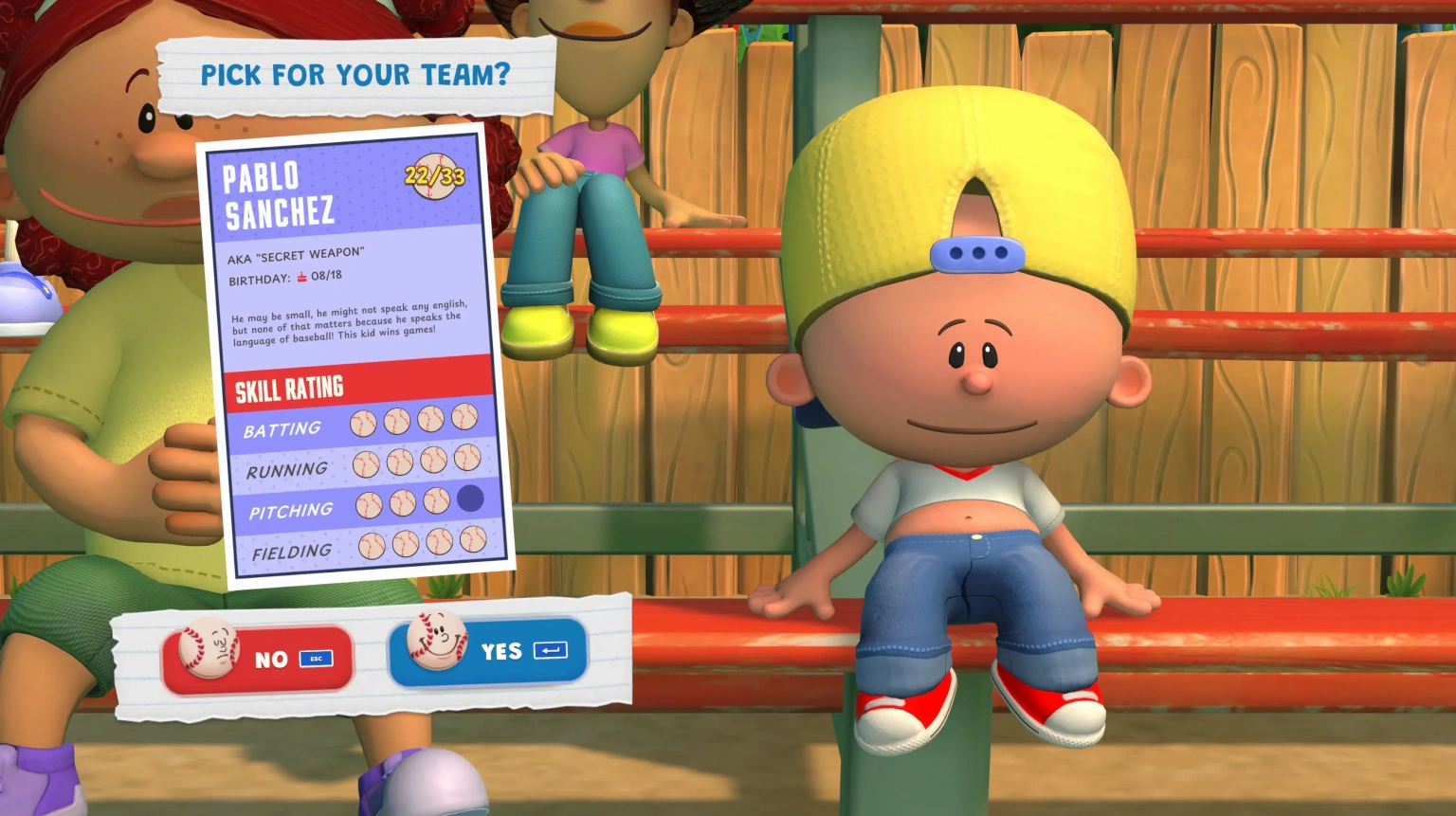
The Card Shop acts as a welcome reprieve from the repetitive, lopsided matches that define the on-field experience. Spending time opening packs provides a genuinely refreshing loop, driven largely by the inclusion of highly collectible REMIX Cards. These cards showcase exceptional, stylized character artwork created by a talented group of artists. Because the game brings back the classic roster of thirty kids alongside several new additions, players may easily find themselves spending hours browsing through the digital collection.
The game delivers fully on its promises regarding roster size, allowing players to select from all 30 original Backyard Baseball children immediately upon starting a new team. Alongside legendary fan favorites like Pablo Sanchez and Jocinda Smith, the selection features generic players from the 1997 original, including Leah Wayne and Chico Pappas. Furthermore, the developers integrated several Major League Baseball legends into the mix, such as Vlad Guerrero and Jason Giambi. While the total number of characters does not quite match the expansive roster of Backyard Baseball ’01, the inclusion of these iconic names provides an impressive lineup.
However, adding these elite special characters to your active roster is not a straightforward purchase within the Card Shop. Each legend is tied to specific, individual performance milestones, such as hitting a designated number of home runs or stealing a precise amount of bases. The game unfortunately conceals these specific unlock requirements from the start, leaving players unaware of the exact amount of grinding required, though unlocking these classic names ultimately serves as a solid incentive to continue playing.
The Final Review
Reconnecting with familiar characters from childhood sports games offers a potent dose of nostalgia, especially for those who spent years winning virtual championships with them. Unfortunately, in this latest iteration of Backyard Baseball, that nostalgic appeal remains entirely skin-deep, evaporating as quickly as a standard seventh-inning stretch. The reboot leans heavily on fond memories rather than honoring the balanced gameplay that earned the franchise its reputation. The simple, pure joy of the classic entries has been replaced by a lopsided, unrewarding lack of difficulty. Effortless batting and overpowered pitching turn every contest into an uncontested blowout that beautiful artwork and legendary names cannot salvage, leaving behind an incomplete sports experience that fails to round the bases.