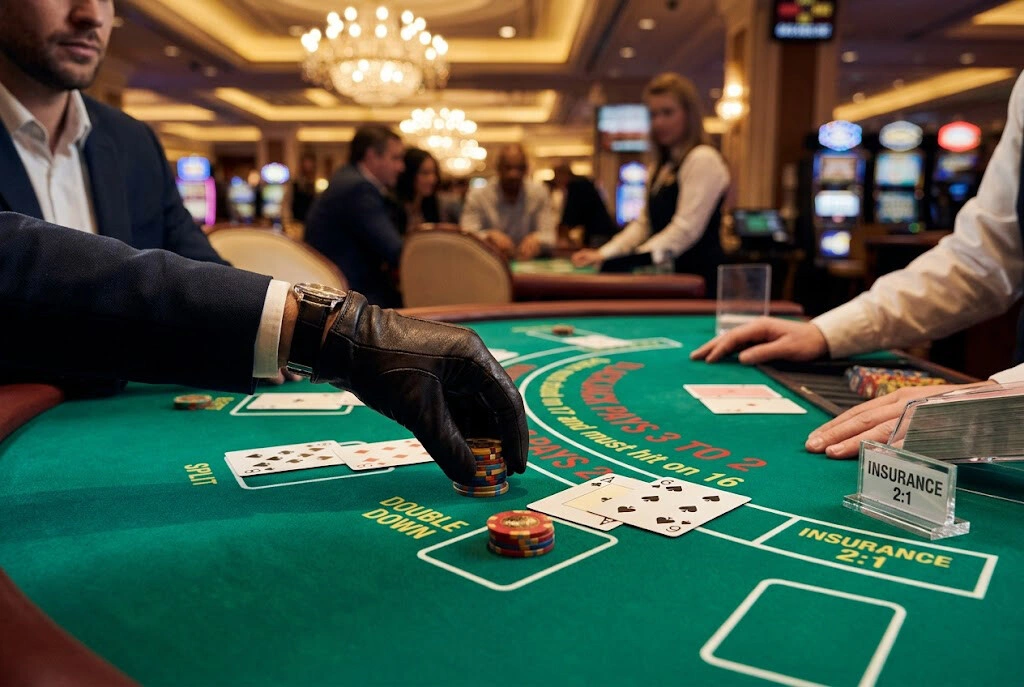

Whether at an online casino, physical table, or in an 18+ video game such as Grand Theft Auto V, blackjack is always one of the most popular games on offer.
Most players already understand the basics. You ask the dealer for cards, trying to beat their score and get to as close to 21 as possible. If you go over and bust, or can’t beat the dealer’s score, you lose the hand. All the while, you’re hoping to hit a blackjack, a perfect hand of an ace and a card worth 10 that pays out at a higher rate of 3:2.
There are some more advanced moves you can make at a blackjack table, too. These are situational, but deployed correctly, can help you increase your winnings. This is how to use them, and once you feel confident, you can consider trying them out at a top sweepstakes site here: https://www.actionnetwork.com/casino/reviews/stakeus-casino
Double Down
This is a move for when the dealer is showing a bust card, meaning their face-up card is one that significantly increases their chances of going bust. Technically a bust card is anything between a two and a six, but taking on the extra risk of a double down is only worth it if the dealer is showing a strong bust card such as a five or six.
The other element is the player must have a hand worth 11 or fewer. This is because a double down allows the player to double their bet in return for receiving one more card, and nobody would pay to potentially go bust.
Let’s say that a player is playing hands worth $10 when the perfect conditions to double down appear, with the dealer showing a six and the player having a hand worth 11. When the player indicates they want to double down, which at an online casino is simply done by clicking the button, another $10 will be moved onto the table.
Should the dealer go bust, or the player’s hand simply beat their score, then this would lead to a $40 win – the $20 stake returned, and $20 of profit. The risk, of course, is that if the dealer wins then the player’s loss has doubled.
Split
If you’re ever dealt two cards of the same value, you’ll be given the option to split them. This again means putting an extra bet in, and the two cards will be separated off into two hands. For example, if you were dealt a pair of tens, you could opt to split them and have each ten be the basis for your two new hands.
The most important thing to consider when deciding whether to split or not is how strong your new hands will be against the dealer. If you have two kings and the dealer is showing a bust card, for instance, the decision is straightforward.
Things get more complicated if it was a pair of sixes, with the dealer showing a ten. A good approach to blackjack is to always assume the next card out the horn will be worth ten, and so splitting here would likely leave you with two hands worth sixteen against a dealer’s twenty. That simply isn’t the kind of position it’s worth investing extra money to get into.
One thing to keep in mind is that the rules are slightly different when splitting aces. Here, you’ll only ever get one extra card on each ace.
Insurance
If the dealer shows an ace, meaning they could have a blackjack, insurance will be offered to the table. This is an extra bet, and the idea is that if the dealer does indeed have a blackjack, you can still break even on the hand. If the dealer doesn’t have a blackjack, though, you immediately lose your insurance money. It might seem like a smart play to protect a hand, but general advice is never to take insurance.
This all comes down to the math behind the bet. Insurance pays out 2:1, however the odds of the dealer having a card that would give them a blackjack are 9:4. This means the house has around a 7% edge and, over a play session, you’re statistically likely to end up down if you take insurance. At the end of the day, the short term protection isn’t worth the cost over the long run.