
An estimated 45,000 game industry jobs were lost between 2022 and mid-2025 – not primarily because studios failed, but because the full in-house model proved too expensive and too rigid to sustain across project cycles. The studios that weathered that period best were not necessarily the biggest. They were the ones who had built their game development team around flexibility rather than headcount.
The shift toward hybrid development reflects a fundamental rethinking of how game production works – and why owning every role and function in-house has stopped making sense for most studios.
The Real Cost of Doing Everything Yourself
Building a fully in-house team means paying full-time salaries, benefits, and overhead for every discipline a project requires. In the US, the average game developer salary sits around $91,000 per year – and that does not include employer taxes and benefits, which typically add another 20-35% on top. A team of 10 senior developers costs over $120,000 in payroll alone every month, whether the project is in full production or not.
That structure works when the pipeline is predictably full. For most studios, it is not – which is exactly why hybrid models built around a lean core team and external specialist support have become the dominant approach for studios that want to stay operational across multiple projects.
5 Reasons to Rethink the In-House-Only Approach
1. Specialized Skills Are Needed in Bursts, Not Permanently
Game development does not require the same skills at equal intensity throughout a project. Concept artists peak in pre-production. Animators are stretched hardest during character and environment phases. QA teams hit maximum capacity near launch. Hiring full-time staff to cover every specialty means paying peak-rate salaries during long stretches where their contribution is minimal.
This is one of the clearest arguments for game co-development as a structural choice: it gives studios access to specialist talent exactly when the project needs it, without the overhead of permanent employment for skills that are only critical during defined phases.
Skills studios most commonly bring in externally for specific phases:
- Concept art and visual development in pre-production
- Motion capture and character rigging during character development
- Console-specific QA and certification compliance before launch
- Localization and audio mixing in the final production stage
- VFX and shader work during environment production
2. A Bad Hire Costs More Than Most Studios Budget For
Sourcing, vetting, and onboarding a single game developer takes an average of six to eight weeks in the best case. For specialist roles, it often takes longer. When the hire does not work out – through a skills mismatch, a project pivot, or a culture issue – the total cost of that failure in technical roles typically reaches 50% to 200% of the person’s annual salary, once recruitment time, onboarding investment, and team disruption are counted.
Working with an established co-development studio removes much of this risk. A specialist partner comes with an existing team structure and a track record that can be evaluated before any agreement is signed. The contractual nature of the relationship also means that scope adjustments do not require redundancy processes.
3. Development Workload Is Cyclical, but Payroll Is Not
Production does not follow a flat workload curve. There are periods of intense parallel effort across art, engineering, and design – and periods of narrow, focused work. Post-launch, many roles have little to do until the next project is ready.
The industry saw this play out at scale between 2022 and 2025. Studios that had expanded during the pandemic growth period found themselves carrying headcount their pipelines could not sustain. The result was a wave of layoffs affecting tens of thousands of developers across every tier of the industry. A hybrid model addresses this structurally rather than reactively.
| Team Structure | Scalability | Cost During Downturns |
| Fully in-house | Low | High – payroll continues between projects |
| Fully outsourced | High | Low – no standing team to maintain |
| Hybrid core + external | High | Low to medium – lean core, flexible peaks |
4. Global Talent Pools Without Relocation or Visa Complexity
When a studio hires in-house, its talent pool is limited by geography – who is already nearby or willing to relocate. For specialist roles like engine programmers, technical artists, or platform certification experts, that is a significant constraint. These skills are not evenly distributed across every city where studios happen to be based.
External development partners operate with global talent structures by design. Engaging a specialist studio in Eastern Europe, Southeast Asia, or Latin America means immediate access to teams that have already shipped titles across multiple platforms – without visa sponsorship, relocation packages, or a prolonged local hiring process.
Practical advantages of global partner access:
- Specialists who already function as a cohesive team
- No dependency on local hiring markets for niche skills
- Competitive cost structures reflecting regional salary benchmarks
- Time zone coverage that can extend effective working hours
5. Shared Expertise Speeds Up Problem-Solving
When a studio hires a developer, that person brings their individual experience. When a studio engages a specialist team, it gains the collective knowledge of everyone who has worked on similar problems across multiple previous projects. That difference matters most when something unexpected happens mid-production – and in game development, something unexpected almost always does.
A platform certification failure, a performance bottleneck, a late scope change – these are situations where pattern recognition from prior experience outweighs raw ability. A team that has solved the same class of problem five times across different projects will resolve it faster and with less disruption than one encountering it for the first time. That accumulated judgment is not something headcount alone can replicate.
What the Hybrid Model Actually Looks Like
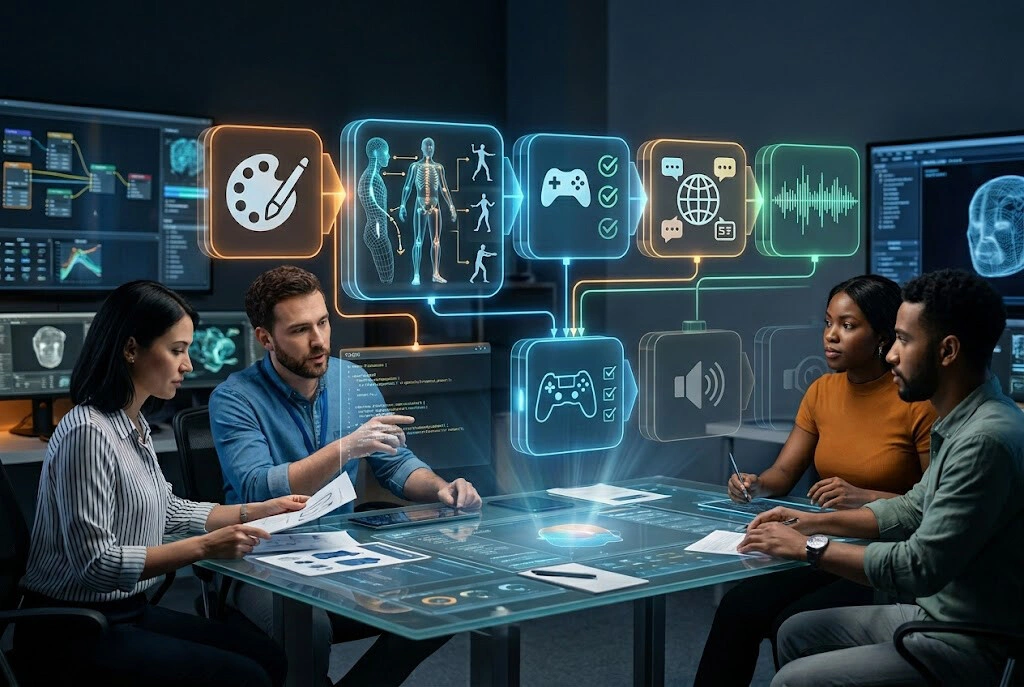
The studios that use hybrid structures most effectively make deliberate decisions about what to own permanently and what to access flexibly. A common structure includes:
- Core in-house team: Creative director, lead engineer, producer – people whose institutional knowledge is essential throughout every phase
- Integrated external team: Specialist developers embedded into the production pipeline for defined phases, working through the same tools and milestone structures as the internal team
- Task-based external support: Specific deliverables – an asset batch, a localization pass, a QA sprint – handled without deep project integration
What makes this work is clarity about ownership upfront. When roles and responsibilities are defined before work begins, a hybrid structure functions as one cohesive production. When they are not, the friction between internal and external teams becomes its own source of delay.
Game Building in 2026: Final Thoughts
The game development outsourcing market was valued at $1.86 billion in 2024 and is projected to reach over $9 billion by 2034. That trajectory reflects something more than cost pressure. It reflects a structural recognition that the most effective studio in 2026 is not the one that employs the most people – it is the one that assembles the right capabilities for each project, holds them together through clear process, and releases them without the overhead burden that follows.
FAQ
Does using external partners mean giving up creative control? Not with a well-structured engagement. Control comes from clear scope, milestone-based reviews, and defined approval processes – all of which apply equally to internal and external teams. Studios that report losing control typically had vague scope agreements, not a fundamental problem with the hybrid model itself.
What roles should always stay in-house? Creative direction, lead engineering decisions, and production management are the functions most studios keep internal. These require the deepest project context and most consistent presence across the full development cycle.
How does quality stay consistent across internal and external teams? Through the same mechanisms that manage internal quality: defined deliverable specifications, regular reviews, and clear revision processes. External teams need these structures written into the contract, where internal teams often rely on institutional norms built over time.
Is a hybrid model only for large studios? No. Indie studios use external art and QA support to compete above their weight class on production quality. Mid-size studios use specialist partners for disciplines they cannot justify hiring full-time. The approach scales with the project, not the studio size.
What happens if an external partner runs into trouble mid-production? This risk is real and should be addressed in the contract – specifically around source code ownership, documentation requirements, and transition planning. It is manageable when planned for upfront, and significantly harder to handle when it is not.