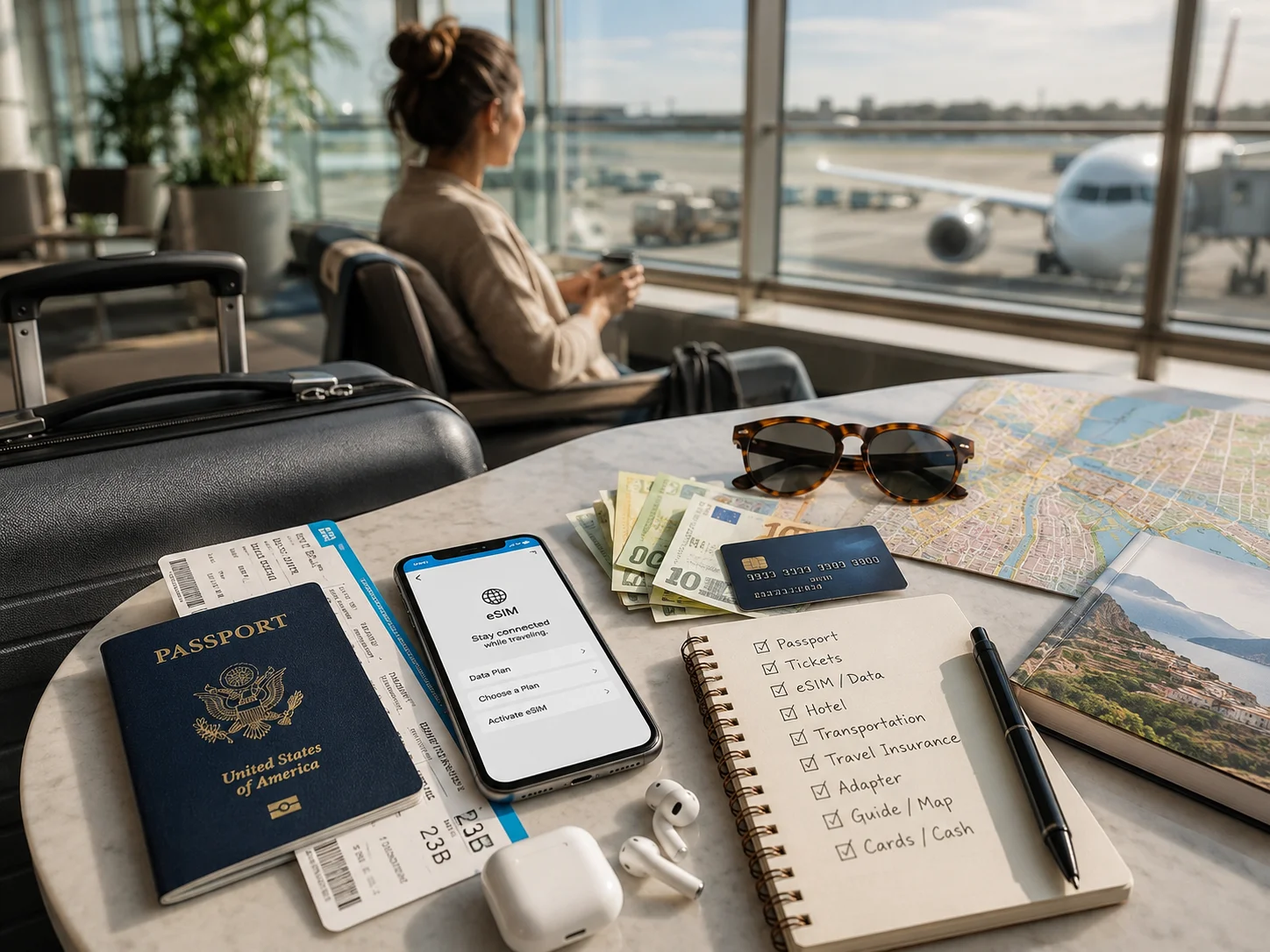

Americans take more than 90 million international trips annually, yet most travelers repeat the same avoidable mistakes trip after trip. Overpaying for currency exchange, missing free museum hours, burning money on roaming charges, and booking flights at the wrong time are not unlucky outcomes: they are the predictable result of skipping a handful of preparation steps that take minutes. These travel hacks apply to virtually every international destination and pay off on every trip.
Before You Leave Home
1. Check Your Passport Expiration Date Right Now
Most countries outside the US require your passport to have at least six months of validity remaining beyond your departure date. A passport expiring in four months is functionally expired for most international travel. Passport renewal currently takes six to eight weeks through standard processing. Expedited service costs more but runs two to three weeks. If you travel internationally even once a year, renew at the eight-month mark rather than waiting until it expires.
2. Activate a Travel eSIM Before You Board
US carrier international roaming plans charge $10 to $25 per day in most international markets. That is $140 to $350 on a two-week trip before a single call is made, added to your regular monthly bill. A travel eSIM activated before departure costs a fraction of that for the same coverage or better. Holafly travel eSIM covers over 200 destinations with unlimited data plans you activate by scanning a QR code from home. Your US number stays active on your physical SIM for calls and texts. Setup takes five minutes and saves real money on every trip.
3. Photograph Every Document Before You Leave
Passport, visa, travel insurance policy, credit card numbers, emergency contacts, and hotel confirmation numbers should all be photographed and stored in a secure cloud folder accessible from any device. If your bag is stolen in Rome or your phone goes into a river in Thailand, these photographs are the difference between a recoverable situation and a travel-ending crisis. Takes ten minutes. Do it every trip.
4. Notify Your Bank and Credit Cards
Cards flagged for unusual foreign activity are blocked automatically. Resolving this from a foreign country adds hours of frustration and sometimes leaves you without access to funds at critical moments. Most banks allow travel notifications through their app in under two minutes. Set them for every card in your wallet.
5. Download Offline Maps Before You Fly
Google Maps allows you to download entire cities and regions for offline use. Do this on your home WiFi before departure. In combination with a travel eSIM for data, offline maps serve as backup when you are in areas with weak signal, underground, or in a country where the eSIM hasn’t activated yet. Also download the offline language pack for Google Translate for your destination language. The camera translation feature works offline and is one of the most genuinely useful travel tools ever built.
At the Airport
6. Use Priority Pass or Credit Card Lounge Access
Several US credit cards include Priority Pass membership or direct lounge access as a card benefit. The Chase Sapphire Reserve, Amex Platinum, and Capital One Venture X all include lounge access that covers airport lounges worldwide. Free food, comfortable seating, reliable WiFi, and showers at international airports are worth significantly more than the card’s annual fee if you travel more than twice a year. Check your existing cards before assuming you do not have access.
7. Check In Online and Go Straight to Security
This is obvious and yet a substantial percentage of American travelers still check in at the airport counter. Online check-in opens 24 hours before departure for most airlines. Checking in from your phone saves between 20 and 45 minutes at international airports, more during peak travel periods. Add your boarding pass to Apple Wallet or Google Pay and you will not need to search for it at the gate.
8. Pack a Day Bag That Fits Under the Seat
On international flights, overhead bin space fills quickly. A soft bag that fits under the seat in front of you means your carry-on is always accessible regardless of how full the bins are. Keep your valuables, medications, travel documents, and anything you need during the flight in the under-seat bag. This also speeds up deplaning significantly since you are not waiting for bins to clear.
Money and Currency
9. Never Exchange Currency at the Airport
Airport currency exchange desks consistently offer rates 8 to 15 percent below the interbank rate. On a $500 exchange, that is $40 to $75 in pure margin. ATMs at your destination consistently offer better rates. Banco do Brasil in Brazil, Post Office ATMs in the UK, and bank ATMs generally in Europe all provide rates far closer to the real exchange rate than airport exchange desks. Withdraw local currency on arrival rather than before departure.
10. Get a No-Foreign-Transaction-Fee Credit Card
Most standard US credit cards charge 2 to 3 percent on every international transaction. On a $3,000 trip that is $60 to $90 in invisible fees. Cards from Chase, Capital One, and Schwab that eliminate foreign transaction fees are available at no extra cost and pay for themselves on a single international trip. The Charles Schwab debit account additionally reimburses all international ATM fees globally, which is the single most useful financial tool for American travelers who use ATMs abroad.
11. Keep Small Bills in Local Currency
Taxis, market vendors, street food stalls, and smaller restaurants in most countries do not make change easily. Arriving at a destination with $50 to $100 worth of local currency in small denominations smooths the first 24 to 48 hours before you establish a normal routine. Ask your home bank for small bills when ordering foreign currency, or break larger ATM withdrawals at a hotel or supermarket purchase immediately after landing.
At Your Destination
12. Eat Where Locals Eat, Not Where the Signs Are in English
Restaurants that post their menus in English, display photos of every dish, or position a host outside to usher in passersby are optimizing for tourist turnover rather than food quality. In virtually every international city, the best food at the best prices is in the neighborhoods one metro stop beyond the main tourist district. Look for places where the menu is written on a chalkboard, where the staff does not speak English, and where every table is occupied by people who clearly live there. This rule works in Tokyo, Rome, Istanbul, and Mexico City equally.
13. Use Museo Free Hours
Major museums worldwide offer free admission during specific hours. The Thyssen-Bornemisza in Madrid is free on Mondays from noon to 4pm. The British Museum in London is always free. The Louvre in Paris offers free admission on the first Sunday of each month. The Uffizi in Florence offers free entry on the first Sunday of the month from October through March. Spending fifteen minutes researching free admission windows for your target museums before departure saves $20 to $60 per museum per person.
14. Take Public Transport at Least Once
The metro, bus, or commuter rail in virtually every major international city is faster, cheaper, and more revealing than taxis for most journeys. Paris Metro, Tokyo’s JR lines, London Underground, and the Madrid Metro all move tourists as efficiently as locals, and the experience of navigating a foreign transit system successfully is one of the low-key satisfactions of international travel. Buy a rechargeable transit card on arrival and use it for at least half your urban journeys.
15. Build One Unscheduled Day Into Every Trip
The most consistent regret expressed by experienced American travelers is over-scheduling. A two-week international trip with activity booked from 9am to 9pm daily produces exhaustion, not memories. Building one completely unscheduled day into the middle of any trip creates space for the recommendations you get from your hotel desk clerk, the neighborhood you walk through by accident, and the restaurant with no English menu that turns out to be the meal you remember longest.
Travel Hacks FAQs
What is the single most impactful travel hack for Americans going abroad? Activating a travel eSIM before departure. Roaming charges are the single most consistent source of bill shock for American international travelers, and the solution requires five minutes of setup at home. Everything else on this list improves the experience. This one prevents a $200 to $400 charge on your next phone bill.
How early should I apply for passport renewal? Apply at least three months before your travel date for standard processing. Six months before is safer. If your passport expires within eight months, renew now rather than waiting until a trip is planned.
Are credit card travel protections worth relying on? Premium travel cards from Chase, Amex, and Capital One include trip cancellation insurance, lost baggage reimbursement, and travel accident coverage that genuinely pays out. Read the benefits guide for your specific card before each trip to know exactly what is covered and what the claim process requires.
Is it safe to use ATMs abroad? Yes, with standard precautions. Use ATMs attached to bank branches rather than standalone machines in tourist areas. Shield your PIN when entering it. Check for skimming devices by pulling on the card reader before inserting your card. These precautions apply equally in the US and abroad.